One of the most common questions we get from new Goldendoodle families is also one of the most important: "How much exercise does my puppy need?" It sounds simple, but the answer changes more than you might expect between eight weeks and eight years old. Get it right, and you raise a calm, confident dog with strong joints and a long adventure-ready life. Get it wrong, and you can unintentionally cause damage that doesn't show up until your dog is two or three years old.
This guide walks you through the right kind and amount of activity for every stage of your Goldendoodle's life — from the wobbly puppy you bring home at eight weeks to the seasoned hiking buddy you'll have for years to come.
Why Exercise Looks Different at Every Age
Goldendoodles inherit boundless energy from both the Golden Retriever and Poodle sides of their family tree. That energy is wonderful — it's what makes them such fun, playful companions — but it also means owners often assume more exercise is always better. It isn't. Puppies are still building their bodies, and their joints, ligaments, and growth plates aren't ready for the same workouts an adult dog can handle.
Good breeding plays a part here too. The foundation you start with matters — our mommas are health-tested for hips, elbows, and eyes before they ever have a litter, and that genetic head start gives every puppy a better chance at a lifetime of easy movement. But genetics alone can't outrun a puppy that's been pushed too hard too early.
Think of it the way you'd think about a child's body. A six-year-old running a 5K once is fun; a six-year-old running a 5K every day is asking for stress fractures. The same logic applies to your doodle. Exercise should match the body that's available, not the energy level on display.
Puppyhood (8 Weeks – 6 Months): The 5-Minute Rule
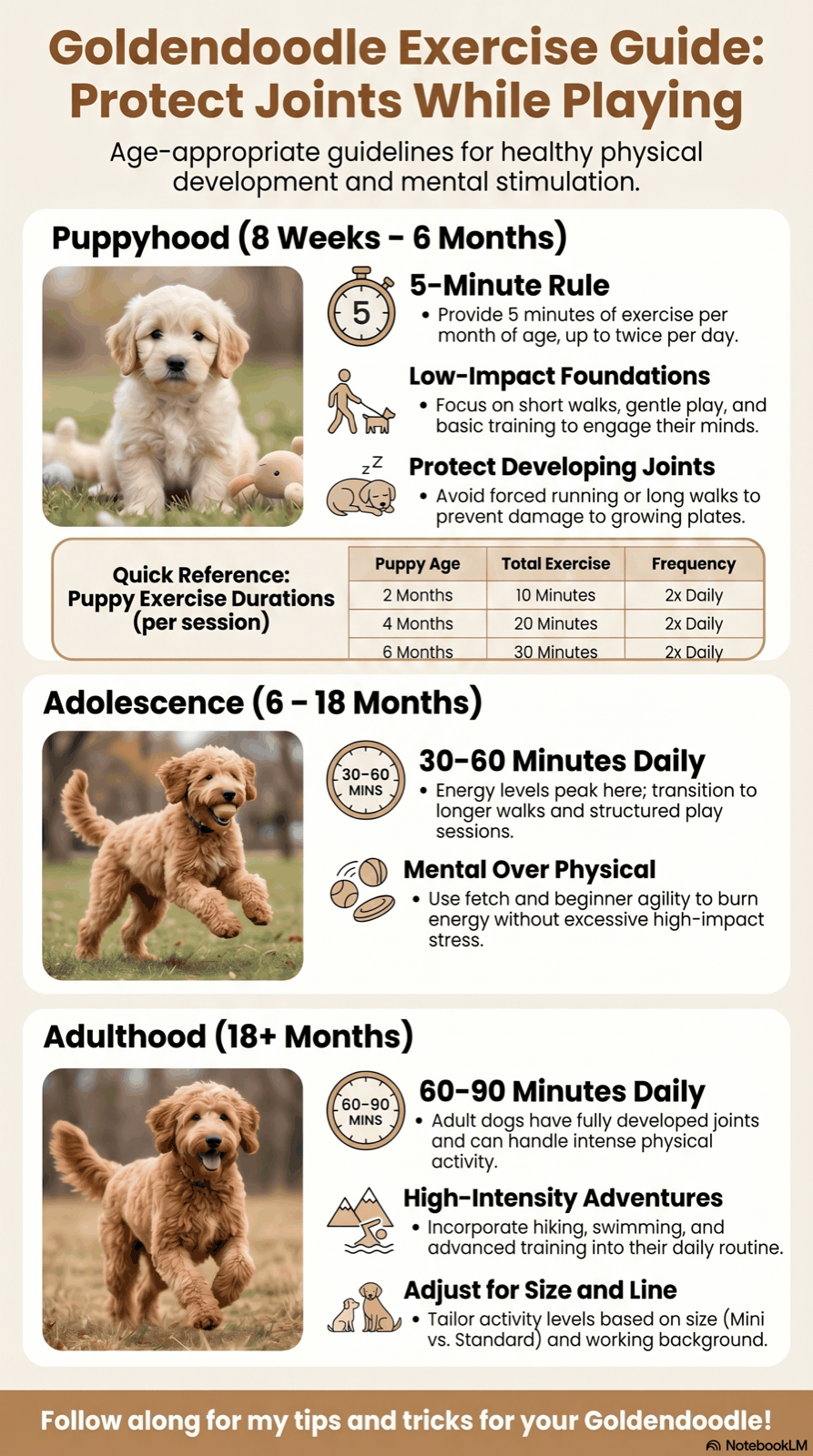
The single most important number to remember during your puppy's first six months is five. The widely respected guideline among veterinarians and breeders is to provide about five minutes of structured exercise per month of age, up to twice per day.
That works out to:
- 2 months: about 10 minutes per session, twice a day
- 4 months: about 20 minutes per session, twice a day
- 6 months: about 30 minutes per session, twice a day
Notice we said structured exercise. The five-minute rule applies to walks on a leash, fetch sessions, hikes, or other intentional activities. Free play in the backyard, where your puppy can stop and rest whenever they want, doesn't fall under that cap. Puppies are excellent self-regulators when no one is asking them to keep going.
What to Focus On
- Short walks on soft surfaces. Grass and dirt are easier on joints than concrete and asphalt.
- Gentle play and exploration. Sniff walks and slow neighborhood strolls do more for development than long, fast outings.
- Basic training sessions. Mental work tires a puppy out as much as physical exercise — and is a much better use of those early months.
What to Avoid
- Forced running. No jogging beside you, no treadmills, no running alongside a bike. Their growth plates haven't closed yet, and repetitive impact at this age is one of the leading causes of hip and elbow problems later.
- Long hikes. Save the trail miles for after their first birthday.
- Repeated jumping. Off the couch, in and out of the car, up and down stairs — keep these to a minimum during the growth window.
- Stair climbing in repetition. A few flights here and there are fine; using stairs as exercise is not.
Quick rule of thumb: if your puppy is panting heavily, lagging behind, or lying down on a walk — they're done. Pick them up or turn around. Pushing through is never worth it during the growth window.
Adolescence (6 – 18 Months): Channel the Zoomies
Welcome to the teenage years. By six months, your Goldendoodle has more energy than they know what to do with — and they'll happily prove it by doing laps around the living room at 9 p.m. Their bodies are bigger and more capable now, but the growth plates in their long bones are still closing (typically between 12 and 18 months for medium and standard sizes).
The goal during this stage is to channel that energy thoughtfully without piling on high-impact stress.
Aim for 30 to 60 minutes of activity per day, broken into two or more sessions. Mix it up between physical movement and brain games — adolescent doodles are notoriously easy to bore, and a bored doodle becomes a chewer of shoes.
Great Activities for This Age
- Longer walks on varied terrain. Sniff walks, leash walks through the neighborhood, gentle hikes on flat trails.
- Fetch and tug. Excellent energy burners. Keep fetch sessions on flat, soft surfaces and avoid sharp turns.
- Beginner agility or trick training. Low jumps and tunnels are fine if your vet has cleared it; skip the high-impact obstacles for now.
- Swimming. If your doodle takes to water, this is the gold standard — full-body workout with zero joint impact.
- Puzzle toys and scent games. Fifteen minutes of nose work can wear out a doodle as much as an hour-long walk, and building that kind of routine structure pairs beautifully with solid crate habits.
This is also the perfect age to start building manners on walks, working on recall in safe areas, and introducing your doodle to new environments. Mental enrichment isn't a substitute for physical exercise — it's a multiplier. A walk where your dog actually gets to sniff, decide, and explore is worth two on a tight leash.
Adulthood (18+ Months): Adventure Ready

Once your Goldendoodle's growth plates have closed (your vet can confirm this if you're unsure), the world opens up. Adult doodles are athletic, durable, and built for the kinds of activities most families dream of doing with their dog.
Most adult Goldendoodles thrive on 60 to 90 minutes of exercise per day, ideally a mix of physical and mental activity.
What's Now on the Menu
- Hiking. Hills, distance, multi-hour trails — go for it. Always pack water.
- Running and jogging. If you're a runner, your doodle can finally be your training partner. Build distance gradually, just like you would for yourself.
- Swimming and paddleboarding. Full-body workouts that double as cooling activities in summer.
- Advanced training. Agility, dock diving, scent work, therapy dog certification — adults are ready for serious skills.
- Dog sports and group play. Most adults love structured romp time at a well-managed dog park or friend's yard.
Adjust for Size and Build
Not every adult Goldendoodle has the same engine. A 25-pound mini doodle and an 80-pound standard doodle will both be happy with that 60–90-minute window, but the type of activity matters. Standards generally have more endurance for long hikes and running. Minis often prefer shorter, more frequent bursts and excel at agility or fetch in smaller spaces. Pay attention to your individual dog — they'll tell you what they love.
Signs You're Getting It Right (or Wrong)
The best feedback comes from your dog. Here's what to watch for.
Right amount of exercise looks like:
- A calm, settled dog at home between sessions
- Healthy appetite and steady weight
- Sound, easy movement — no limping or stiffness
- Eager but not frantic when it's time to go out
Too much (especially in puppies and adolescents) looks like:
- Limping after activity, even if it goes away within a day
- Reluctance to walk, jump, or climb stairs
- Stiffness when getting up from a nap
- Excessive panting or lying down to refuse to continue
Not enough looks like:
- Destructive chewing, digging, or scratching
- Inability to settle inside the house
- Weight gain
- Excessive barking or attention-seeking
Frequently Asked Questions
Can I take my Goldendoodle puppy on a hike at 4 months?
Not a real hike. At 4 months, stick to about 20 minutes of structured exercise per session, twice a day, on soft surfaces like grass or dirt. Save trail miles for after your puppy's first birthday, once growth plates have started to close.
When do Goldendoodle growth plates close?
For medium and standard Goldendoodles, growth plates in the long bones typically close between 12 and 18 months. Minis can close slightly earlier. Your vet can confirm with an exam or X-ray if you're unsure before starting higher-impact activity.
How much exercise does an adult Mini Goldendoodle need vs. a Standard?
Both thrive on roughly 60 to 90 minutes of daily activity, but the type matters. Standards have more endurance for long hikes and running, while Minis often prefer shorter, more frequent bursts and excel at fetch and agility in smaller spaces.
Is swimming safe for Goldendoodle puppies?
Yes, gentle, supervised swimming is one of the safest forms of exercise because it's zero-impact on growing joints. Keep sessions short, always support your puppy in deep water, and make sure they can exit the water easily.
What are the signs my Goldendoodle is getting too much exercise?
Watch for limping after activity (even if it fades by the next day), stiffness when getting up from a nap, reluctance to walk or climb stairs, and excessive panting or lying down to refuse to continue. Any of these means it's time to dial back, especially during the puppy and adolescent stages.
Key Takeaways
- Puppies (8 weeks – 6 months): Five minutes per month of age, twice daily. Skip the long walks and the running — protect those growing joints.
- Adolescents (6 – 18 months): 30–60 minutes daily. Mix physical activity with mental enrichment, and keep impact low until growth plates close.
- Adults (18+ months): 60–90 minutes daily. The world is yours — hiking, swimming, running, agility, and beyond.
- Always: Watch your individual dog, prioritize quality over quantity, and remember that mental work counts.
Raising a Goldendoodle is one of the most rewarding things a family can do, and giving them the right kind of activity at the right age is one of the simplest gifts you can offer them. A well-exercised doodle is a happy doodle — and a happy doodle is the dog you'll want to keep up with for the next twelve to fifteen years. It's also the reason we back every puppy with a health warranty — sound joints and a long, active life are the baseline we're aiming for.
Have questions about your puppy's exercise routine, or about anything else in their first year? Reach out anytime — we love helping our families raise the healthiest, happiest Frosted Goldendoodles possible.